Monday, April 12, 2010

Хасково (Haskovo)

To be honest, I had no interest in spending any time in Хасково (Haskovo), a feeling which had been reinforced as we made our way into town and past one depressing communist-era apartment block after another. I was in Haskovo only because there was a daily bus from there to my intended destination, Маджарово (Madzharovo). As the bus rolled into the station, I was feeling pretty good. A typical Monday involved teaching and lesson planning. But this wasn’t a typical Monday. It was spring break. It was 3:30 in the afternoon, and the bus to Madzharovo didn’t leave until 4:00. That left plenty of time to buy my ticket, stretch my legs, and maybe even enjoy a cold beer. But there was a problem. The one and only daily bus from Haskovo to Madzharovo had long since departed. It left daily at 2:30, not 4:00. The next bus to Madzharovo didn’t leave for another twenty three hours.

I called my contact in Madzharovo. I explained my situation, and he told me he would call back in fifteen minutes. Thirty minutes later, one of my contact’s colleagues called. I was in luck. Another colleague who lived in Haskovo was willing and able to drive us to Madzharovo. They would be ready to go in a couple hours and would call me back when they were ready. In the meantime, I was free to explore Haskovo.

My initial thoughts regarding Haskovo couldn’t have been more wrong. It’s no utopia, but it’s anything but the ugly and depressing place I thought it to be. With a laid-back vibe, manicured gardens, and a modern, pedestrianized center with a surprising number of shops and cafés, Haskovo is actually a rather pleasant place to be stuck for a couple hours. I suspect deeper digging might reveal a far less sunny side of Haskovo. I also wonder how the investment in and renovation of the city center will ultimately pan out. But, in the absence of such scrutiny and foresight, Haskovo is a quite agreeable and enjoyable town.

Only two of the town’s original seven mosques remain. One of them, Eski Mosque is the oldest in the Balkans. The minaret of Eski Mosque is in the background here.


The investment in Haskovo's modern, pedestrianized center gives the town a much different feel than many Bulgarian towns, whose city centers seem to be dying.


Among other things, Haskovo boasts the world’s tallest monument to the Virgin Mary. The thirty two meter high statue, which was dedicated in 2003, can be found on the Hill of Youth on the edge of the city center.


A view of town from the Hill of Youth.


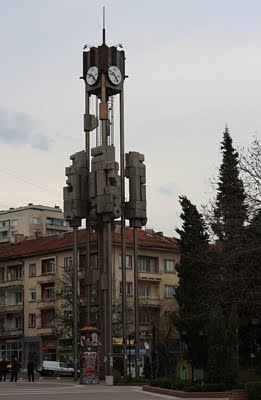
Haskovo celebrated its 1000th anniversary in 1985. To mark the occasion, this monstrosity was erected.

Sunday, April 4, 2010

Easter in Bulgaria

At one of my conversational English classes this week, the topic of discussion was plans for Easter. An overwhelming majority of Bulgarians belong, at least nominally, to the Bulgarian Orthodox Church, which is Christian. Accordingly, I was curious to learn how some of the Bulgarians I know planned to spend Easter weekend.

The first person in the group began by saying she never planned anything and, accordingly, had no idea what she would do over the weekend. She then said something that really took me aback. She said that she was under the impression that Easter is not celebrated in America. While I realize that most Americans are ignorant and uninformed regarding Bulgaria and Bulgarian culture, it never occurred to me that a large number of Bulgarians might be similarly ignorant and uninformed regarding America and American culture.

I explained to her that while not everyone in America observes Easter, as not everyone is Christian, a majority of Americans are Christian and do celebrate Easter. I talked of lent, church services, and our family’s traditional Easter meal, but I mainly talked about the commercialization of Easter – Easter egg hunts, the Easter bunny, Easter baskets, and egg-painting and egg-smashing contests. And then I listened as others explained some of Bulgaria’s Easter traditions.

Easter in Bulgaria is called Великден, and it's one of the most significant holidays on the Bulgarian calendar. Here is what I could gather from talking to my class:

• On Maundy Thursday, it is customary to dye hard-boiled eggs. The first egg should be dyed red, to symbolize the blood of Christ. This egg is then supposed to be put aside – either to be kept in the home for the coming year (for good luck) or buried in the fields (to ensure fertility).

• Tables are set up at church representing Jesus’ coffin, and, on Good Friday, you are supposed to crawl under one of the tables. This also theoretically promises health and fertility.

• Saturday night, just before midnight, people gather at church. Shortly after midnight, candles are lit from a "holy fire." Parishioners walk around the church three times with their lit candles and then carry the lit candles home with them, again, to insure good luck and health until the next Easter.

• After the lighting of the candles, some of the dyed, hard-boiled eggs are cracked against each other. This continues over the next few days. People take turns in tapping their eggs against the eggs of others, and the person with the last uncracked egg, or the egg with the fewest cracks, is believed to have a year of good health and fortune.

• On Easter Sunday, there is typically a large family gathering and feast, with lamb usually served as the main course. For dessert, traditional Bulgarian Easter sweetbread – Козунак – is served.

I skipped the dying of eggs and crawling under the table but otherwise celebrated Easter like a somewhat typical Bulgarian. We didn’t walk around the church three times, but we did join lots of other folks from town at church at midnight to get our candles lit from a holy flame. Unfortunately, they all burned out shortly after we started off on our way home. I guess that means none of us will be lucky this year. We also cheated by having our lamb dinner on Saturday night, eating goat instead on Easter Sunday. Anyway, here are some photos and short videos of the festivities along with a few more thoughts.

A shot of some of the dyed eggs with some freshly picked flowers in the background.

Before we went to church on Saturday night, I asked what I should wear. One of my friends immediately responded by telling me it didn’t matter because everyone would be drunk. A bit of an exaggeration to be sure, but most of the sober people I saw were young kids acting as chaperones for their parents. Here is some bad video of people outside the church trying to keep their candles lit.


Making Козунак is hard work. In a country where so many things are homemade, many Bulgarians, including everyone in my conversational English class, now buy Козунак rather than prepare it themselves. But the family I celebrated Easter with still makes homemade Козунак. I helped a little - whisking the eggs and sugar until my arm tired, which wasn't very long - but most of the work was done by my friend, Alex. Among other things, the Козунак must be pounded on the table at least 100 times to remove any air bubbles. Here is Alex's brother, Momchil, doing just that.

Tuesday, March 9, 2010

Be careful what you wish for, because you just might get it.

I was talking to a friend the other day. He’s a former Peace Corps volunteer who served in Uzbekistan. Like me, his primary assignment was teaching English as a foreign language. Among other things, we discussed the difficulties of teaching English in the former U.S.S.R. and its satellites. One thing we agreed upon and laughed about was how the noise that greeted us every time we opened the door and entered school sent a shiver down our spines and made us cringe. It’s a difficult noise to describe. It’s not the noise of children happily playing in a schoolyard. It’s not the sound of kids shuffling between classes and to and from their lockers. It’s the sound of chaos. And it’s a sound which only emanates from schools where teachers are relatively powerless and students control almost everything. It’s a sound I have wished, for several months now, I wouldn’t hear when I opened the door and entered school.

Yesterday I got my wish, fittingly on my birthday. When I walked through the door and entered school, I heard nothing other than the sound of water trickling from a faux waterfall. The school seemed deserted. There was none of the typical chaos – no screaming teachers barely audible over the cacophony of students’ voices, no fights to break up, no students to corral and shepherd to class. I couldn’t have asked for a better birthday present.

But school was quiet for a reason. Over the weekend, a group of former students, in their late teens and early twenties, had been in a car accident. The driver was drunk. He lost control of the car and rolled it several times. Kids died. One of the kids was the older brother of a current student. All of the kids had friends at our school.

Today is the memorial service. The school was even quieter. It sucks. I’ll take the sound of chaos any day over the sound of silence.

Wednesday, March 3, 2010

485 Years

On March 3, 1878, the Treaty of San Stefano was signed, liberating Bulgaria from nearly five centuries of Ottoman oppression and putting Bulgaria back on the political map (for those keeping score, the Turks ruled Bulgaria from 1393 to 1878 ... that's 485 years). In recognition of their emancipation (of sorts), Bulgarians celebrate the National Day of Bulgaria or Bulgaria’s Day of Liberation every year on March 3rd. I'm just enjoying a day off from school, but there will be celebrations around the country - despite the Turks' continued influence in Bulgaria.

Monday, March 1, 2010

Баба Пепи

The most recent баба I interviewed is Баба Пепи (Pepi). When I asked Пепи if I could take a photo of her for the blog and then had to wait for her to brush her hair and put on lipstick, I knew she was going to be different. And she was and is. Here is some of her story.

• Пепи was born in 1938 in Село Радуловци (Radulovtsi). Don’t be confused by the signs to the village which read Родоловци (Rodolovtsi); Пепи claims that she liked that name better and was able to convince the people responsible for putting up the signs to spell it the way she preferred.

• Пепи has two daughters and two grandchildren, a grandson and a granddaughter. The most exciting moment of her life was when her grandson was born.

• Пепи is the youngest of six siblings: her brothers were born in 1919 and 1923, and her sisters were born in 1925, 1929, and 1933.

• When Пепи was six years old, her father died. After fourth grade she moved to Sofia to live with her eldest brother.

• After sixth grade, Пепи’s brother married and had no place for her to live. She then moved in with one of her teachers, who wanted to adopt her. But Пепи moved back to Село Радуловци after just one year. She dropped out of school the following year after completing seventh grade.

• Пепи first met her husband while performing a play in Село Пищане. She ended up choosing him as her spouse because he was nice and he had written her a very beautiful and touching love letter. They were married in 1960, had their first child in 1961, and moved to our town in 1963.

• She wanted to be a hairstylist but ended up becoming an accountant for the cooperative for six years before working as a store manager for twenty-eight years.

• Comparatively speaking, Пепи is well-traveled, having visited Berlin, Prague, Poland, Hungary, and the former Yugoslavia. She also traveled to the Black Sea on an annual basis after getting married.

• Like so many of her contemporaries, she too seems to favor a communist Bulgaria over a democratic Bulgaria. According to her, while there were few choices and a limited number of available products under communism, they were affordable. Now, the stores are full, but the things being sold are too expensive to buy. Furthermore, under communism, she says people lived without fear – without fear of the future or day-to-day survival and without fear of being assaulted, robbed, raped, or murdered. Because such things are commonplace now, along with earthquakes, typhoons, and other natural disasters, she believes the world is soon coming to an end.

• Пепи said she doesn’t give her kids or grandkids advice because they are all smarter than her. She just wants them to be honest, respectful, and hardworking. She is proud of all of them, particularly her two daughters.

As limited as Роза’s photo collection was, Пепи’s was extensive. We sifted through several shoeboxes worth of photos and picked out some of the more interesting ones. I hope to label them at some point, but even without labels they tell a great story.


Баба Марта

A few weeks ago I noticed small stands appearing on the streets of Sofia and in the bus and train stations. The only things being sold at these stands were bracelets of red and white yarn and small red and white yarn figures. I’ve since learned that these items are called мартеници (martenitsi), and they are exchanged on March 1st in honor of Баба Марта ("Grandmother March"). Баба Марта is a mythical figure who theoretically brings with her the end of winter and the beginning of spring. The traditions associated with Баба Марта are quite interesting and well worth reading about. You can either do a Google search for Баба Марта, or read my friends' blog about her.

Баба Роза

Баба Роза (Rosa) is the most recent баба I interviewed. Here is some of what I learned about Роза.

• Роза was born in 1939 in Село Гургулят (Gurgulyat), a small village located nine kilometers from where we now live.

• Роза has two sons and three granddaughters.

• Her parents were loving and kind, and she and her three siblings (two brothers and one sister) had a peaceful and happy childhood.

• As the baby of the family, Роза had minimal responsibility growing up (usually nothing more strenuous than feeding the family chickens and pigs), and she often played with friends. Among other things, she played with toy dogs made of fabric and went sledding.

• Роза’s family had three steers, a cow, a calf, a horse, a donkey, 50-60 sheep, plus pigs and chickens. Each year they would raise baby pigs until they were large enough to sell. They would sell all the pigs except for the mother pig and one young female. The mother pig would then be slaughtered in early winter, and the young female would serve as the new mother pig the following year.

• During World War II, Роза recalls a convoy of Russian soldiers and horse-carts heading through the village on their way to Serbia and eventually Austria. She also remembers hearing about the bombing of Sofia from people who had evacuated the city to Село Гургулят.

• She met her future husband when she was in second grade and he was in fourth grade. They liked each other and started “dating” when she was in ninth grade. At the time, dating consisted of nothing more than going for walks together. A joint coalition of parents and teachers (something like the PTA) kept an eye on the kids and strictly enforced a curfew. In any event, shortly after they started dating, her future husband joined the army and left town.

• From eighth grade through eleventh grade, she attended the school where I now teach. It was the only high school in the area, and eleventh grade was the final grade. She said discipline was not an issue whatsoever. There was no drinking, no smoking, and no drug use. The worst thing that went on was boys playing cards. She recalls her class in eighth grade consisting of nearly 200 students. By the time she graduated from eleventh grade, the number of students had dwindled to fewer than fifty.

• She graduated in June, got married to her sweetheart in November, and gave birth to their first child the following November.

• Like some of the other баби who grew up in villages, Роза lived without electricity until she moved here (she was twenty-one at the time).

• In September of 1959, she and her husband and first child moved from Село Гургулят to our town. She says this was necessary because there was no work in the villages. The local cooperative operated out of our town and was giving away land in an attempt to grow the city. Initially Роза and her husband rented a house, but, in May of 1962, they started building. They finished their house, the first one on the block and still Роза’s home today, in October of 1962.

• For thirty years, Роза was a housewife and an accountant, learning like a sponge from more senior colleagues.

• She once visited Romania for three days as part of her work with the cooperative, and she later visited the former U.S.S.R. on an eight-day holiday.

• Роза liked the social order and security that communism provided. Everyone who wanted to work had jobs, unlike today where none of the young people who live around her have jobs. She also liked the food better, claiming it was more organic. As a result, she is proud to have been and to be a member of the “Червената Бабичка,” a group of old women who remained loyal to the communist party and were largely responsible for keeping them in power in Bulgaria even after democracy came to the country.

• Роза is at peace with and proud of the way she has lived her life and wouldn’t change anything. She has lived an honest life and remained true to herself and what she believes in. She wants her granddaughters to live similarly. Despite having an affinity for Turkish soap operas, she advises her granddaughters to live simply and to avoid the stress of living a soap opera type life. She also stresses to them the importance of having God in their lives.

• She thinks the biggest problem with the world today is that people waste too much time trying to become rich instead of enjoying the company of family and friends.

• She also thinks that the “ignorant” men she grew up around were wiser than the educated people of today. Her reasoning is three-fold: first, back then people were living life instead of watching it and learned through personal experience as opposed to instruction or observation; second, people were more moral and less inclined to cheating and stealing because they feared being shamed by the community; and third, they were God-fearing.

Баба Роза now.


Баба Роза then.


Interestingly, Баба Роза's family didn't have a camera when she was growing up, so she doesn't have any photos until after she was married. I suppose the lack of photos tells as much of a story as the photos themselves would have told. Anyway, here are some family photos from over the years after they got a camera.